
Beer aging is not only about “de novo” off-flavors, it is primarily about the loss of sensory balance (as clearly described by Carolina Maia and David Cook*)
Many aging-related aldehydes are already present at very early stages of brewing, often in bound or poorly perceptible forms. Non- and low-alcohol beers (NABLABs) are even more sensitive to aging. As demonstrated by Margaux Simon in her PhD thesis**, NABLABs suffer from premature oxidation and a marked deficiency in fruity aromas. With an antioxidant capacity roughly half that of conventional beers, fresh NABLABs already contain flavor-active, oxidation-derived odorants such as sotolon, methional, and phenylacetaldehyde.
As beer ages, chemical equilibria progressively shift: fresh aromas fade, while aldehydes become increasingly perceptible, resulting in typical aging attributes such as cardboard, honey, cooked potato, worty notes, increased dryness, and a thin mouthfeel.
In other words: aging does not only create defects, it reveals them by removing balance.
A different approach to beer aging
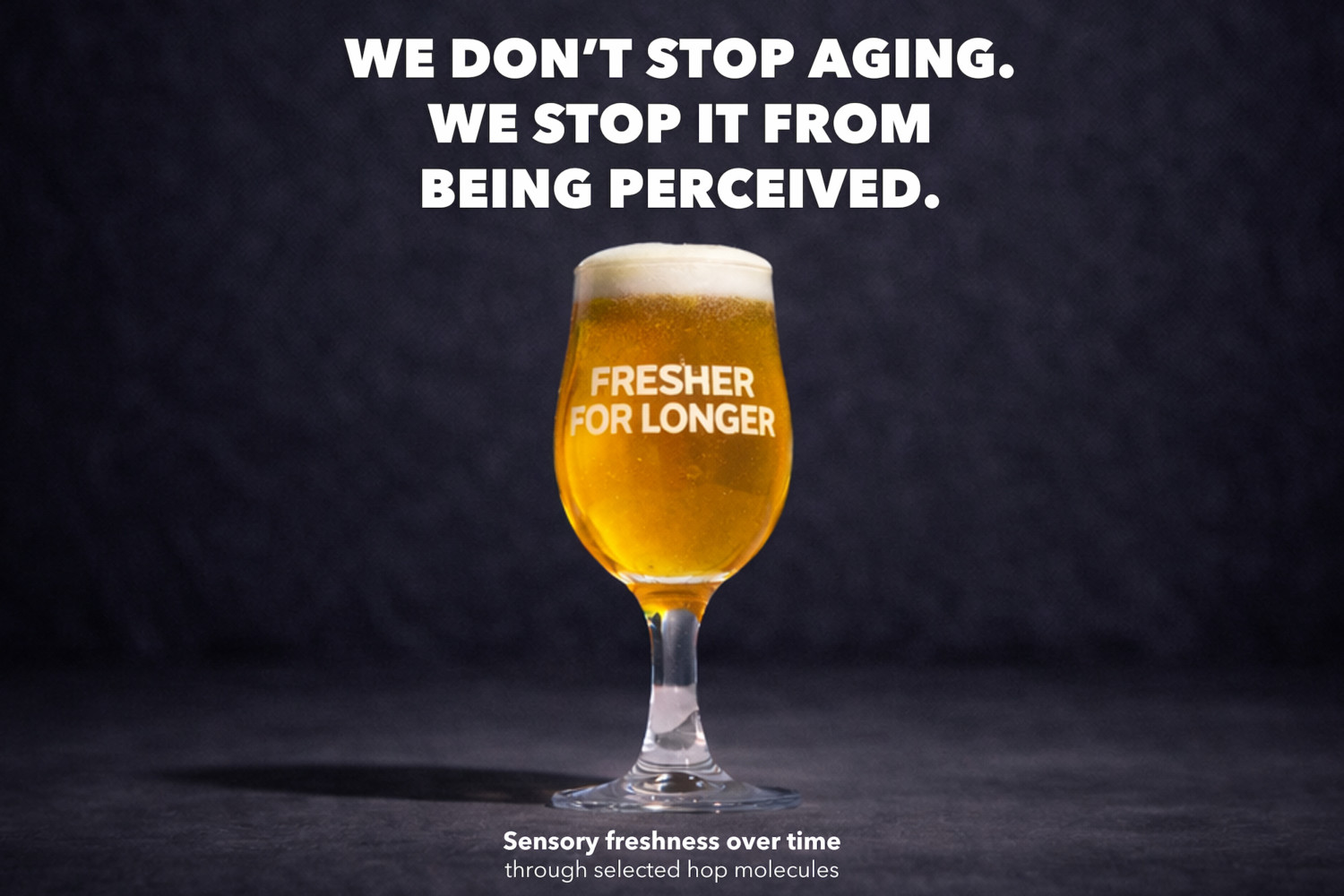
At CBS Brewing, we do not aim to stop beer aging. We aim to stop aging from being perceived.
Rather than chasing unrealistic aldehyde elimination, our strategy focuses on sensory stability: maintaining freshness cues and aromatic balance throughout shelf life, so that aging compounds remain below perception thresholds.
How it works:
In our latest work, we demonstrate how carefully selected hop-derived molecules, used at very low and non-intrusive levels, help preserve sensory freshness over time:
- No impact on beer style
- No added bitterness
- No distortion of the genuine beer taste
These molecules do not bind aldehydes chemically. Instead, they act where it matters most: on perception, by sustaining the aromatic framework that keeps aging notes from emerging.
Selected hop molecules help beer taste fresher for longer.
Key Benefits:
- Fresher taste perception throughout shelf life
- No impact on bitterness, beer style, or genuine taste
- Highly effective in low-alcohol and non-alcohol beers, where freshness loss is faster and more noticeable
Sensory impact, compared to a no-protection beer
| Sensory Attribute | No Protection Beer | Beer with PF-MIX-HOP-AS |
| Cardboard Papery notes |
Become perceptible as hop aroma fades during aging | Strongly reduced, remain below sensory relevance |
| Honey Sweet oxidation notes |
Increase steadily with storage time | Very strongly reduced, fresh aromatic balance dominates |
| Global freshness | Progressively declines | Significantly enhanced, freshness maintained |
| Dryness Thin mouthfeel |
Becomes more pronounced as balance is lost | Clearly reduced, roundness and palate continuity preserved |
| Overall aging perception | Beer perceived as “aged” relatively early | Aging perception delayed, beer tastes fresher for longer |
Final takeaway
Beer aging often amplifies dryness and thin mouthfeel not because new defects suddenly appear, but because aromatic and textural balance disappears. Aging doesn’t only create off-flavors. It removes balance.
CBS PF-MIX-HOP-AS solutions are science-based, validated through analytical and sensory trials, and designed to preserve what truly defines beer freshness, without changing what the beer genuine taste.